
The message that stops your week rarely explains itself. Your forwarder passes on a line from the customs broker: shipment under review, documents queried, please advise. No field name, no line number — a container that was moving yesterday is now waiting on you.
A shipment held at customs for document reasons is usually released by fixing a disagreement between papers: check that the declared value and currency, the Incoterms rule, and the consignee match across the commercial invoice, packing list, and bill of lading or air waybill, then reissue the incorrect document at its source and resubmit through your customs broker.
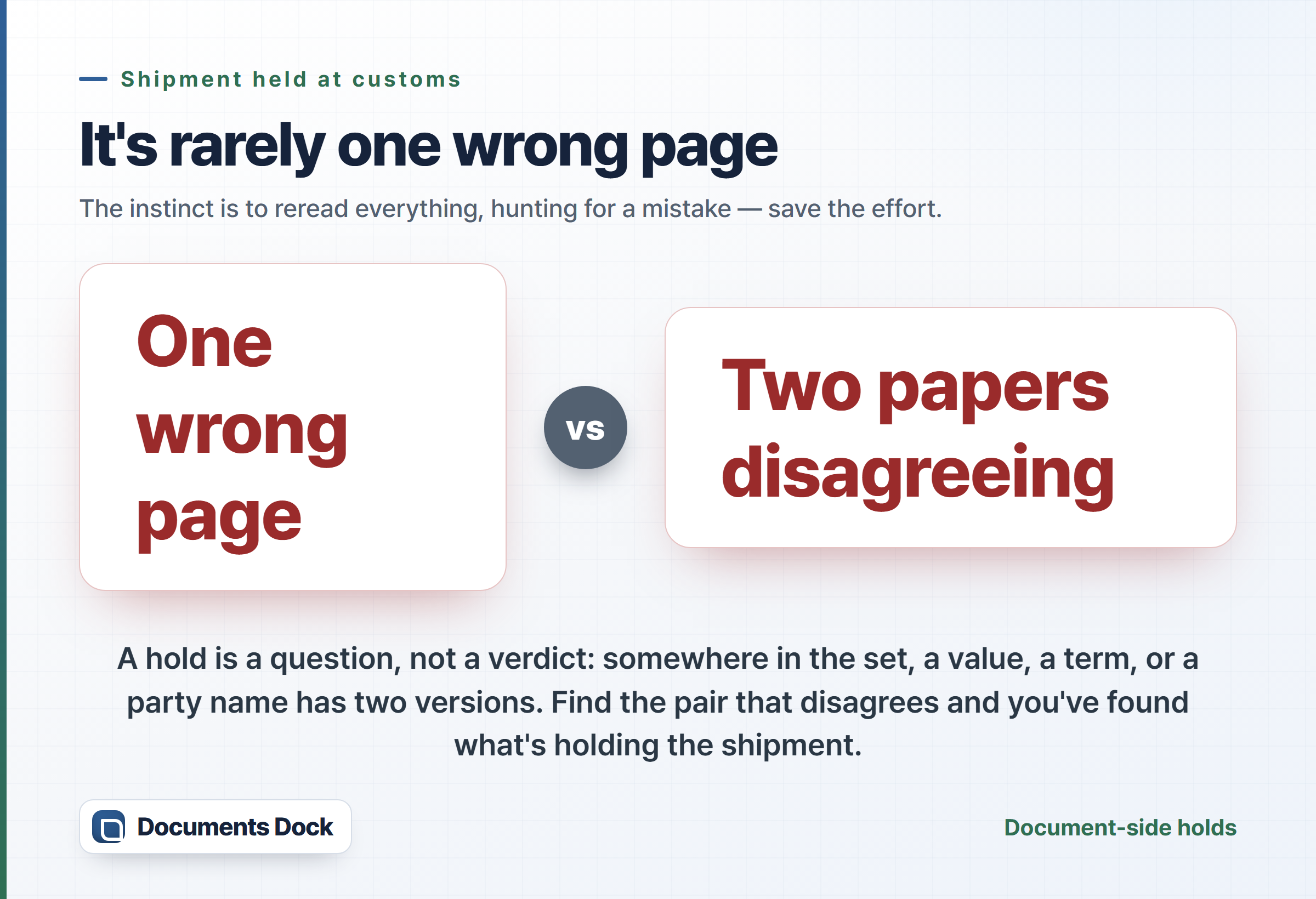
The instinct is to reread every page hunting for a mistake. Save the effort: on most held shipments no single page is wrong — somewhere in the set, a value, a term, or a party name stopped matching from one paper to the next. A hold is the question that follows; an answer — a corrected document or a documented explanation — is what ends it. This guide covers the document-triggered hold and the order to work it in; physical examinations and controlled goods run on a different track — we flag where it splits.
Why is my shipment held at customs?
Shipments are held at customs so the authority can verify something — the declaration, the documents behind it, or the goods themselves — before releasing them. A customs hold is a temporary stop on clearance while that verification happens: a question the authority wants answered, not a finding that something is wrong. Goods-side holds come from physical inspection — random or risk-based checks, controlled goods waiting on a permit; declaration-side holds from the filing itself — a classification or valuation the system flags; document-side holds, the subject here, from the papers: customs cross-reads the commercial invoice, packing list, and transport document, and two of them disagree. Document-side is the common kind for ordinary commercial cargo, and the same few causes repeat across markets:
- A declared value that does not add up — totals, currency, or the invoice version the declaration used.
- An Incoterms rule that contradicts the freight facts, leaving in doubt what the price already includes.
- A consignee or party mismatch — the transport document naming one entity, the invoice and declaration another.
- A description or quantity that drifts between papers — 'stainless-steel water bottles' on the invoice, 'household goods' on the packing list.
The three disagreements to check first: value, Incoterms rule, consignee
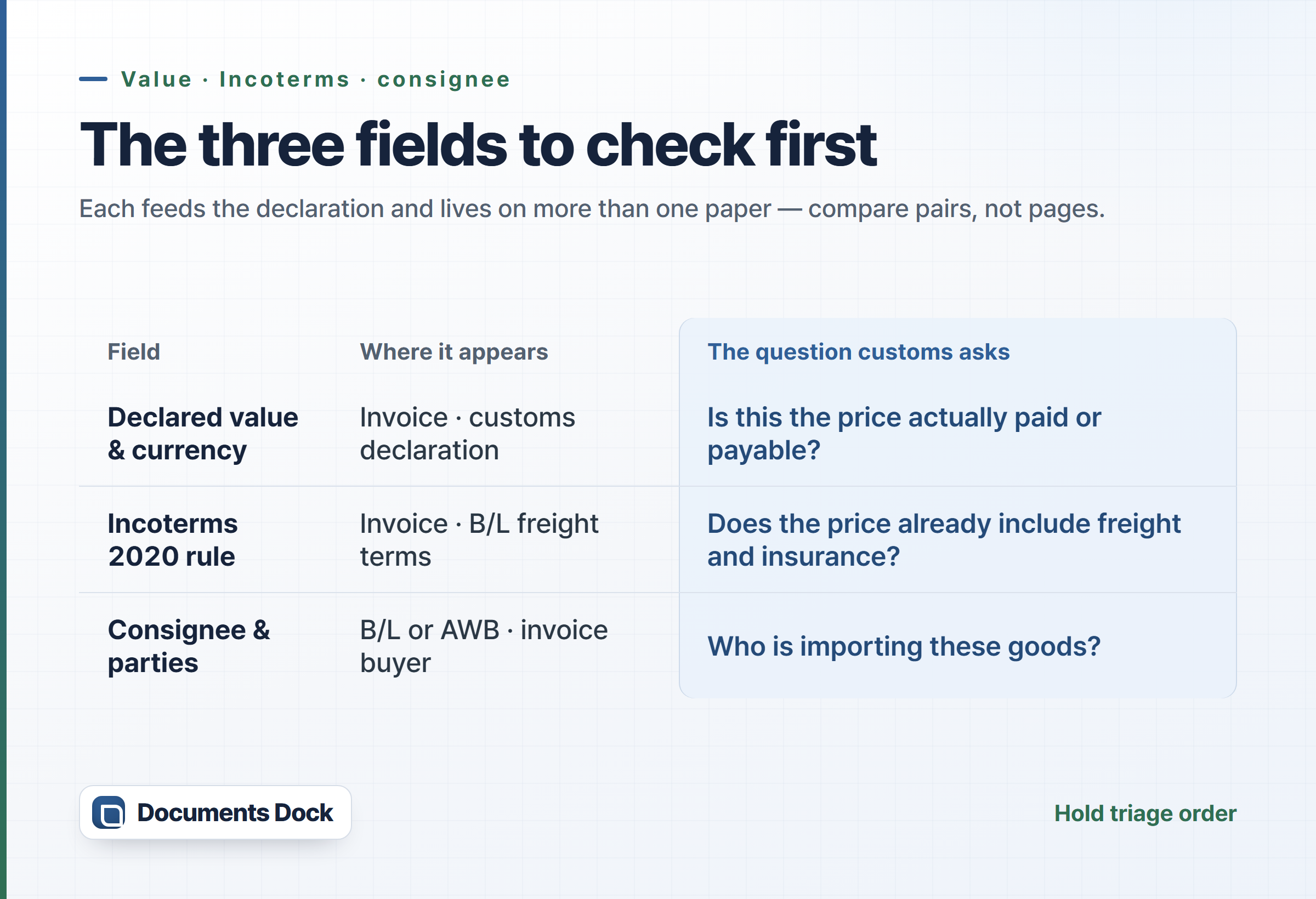
Work the set in this order — these three fields feed the declaration directly, and each lives on more than one paper, where a single fact can end up with two versions.
Value and currency first. The customs value is what import duties and taxes are assessed on; under WTO valuation rules it starts from the transaction value — the price actually paid or payable for the goods. Check that the invoice total equals unit price × quantity, that the currency is stated, and — the version trap — that the declaration was filed from the final invoice. A declaration filed at USD 21,300 from a draft, when the final invoice reads USD 23,100, looks like undervaluation and is actually a stale file. The field-by-field checks live in our commercial invoice guide.
The Incoterms rule second. An Incoterms 2020 rule is one of eleven ICC trade terms setting who arranges and pays for carriage and insurance, and where risk transfers — on an invoice, it tells the broker whether freight and insurance are already inside the price. The classic contradiction: the invoice says FOB, the bill of lading is stamped 'freight prepaid'. Both can be true — but until someone shows who actually paid the freight, the declared value is in doubt, and the shipment waits.
The consignee third. The consignee is the party named on the transport document as receiver of the cargo — the party to whom the carrier releases the goods. Customs reads it against the invoice buyer and the declared importer of record. An invoice billed to your Singapore entity while the bill of lading names a sister company can be legitimate — sold to one entity, shipped to another — but the declaration has to name the right importer and the papers have to support it, or the 'who is importing these goods?' query follows.
Description, quantity, and weight round out the check — the same drift our packing list guide tackles from the prevention side. Two cartons left behind at origin, or 2,150 kg on the packing list against 2,010 kg on the bill of lading: a physical fact becomes a document disagreement the moment only one paper is updated.
The answer is the release
Most document holds are routine verification: clearance stays paused until a specific doubt is resolved — a corrected paper or documented explanation resolves it; pressure without an answer rarely does. Most of the job is locating which field carries the doubt.
What documents does customs need to release a held shipment?
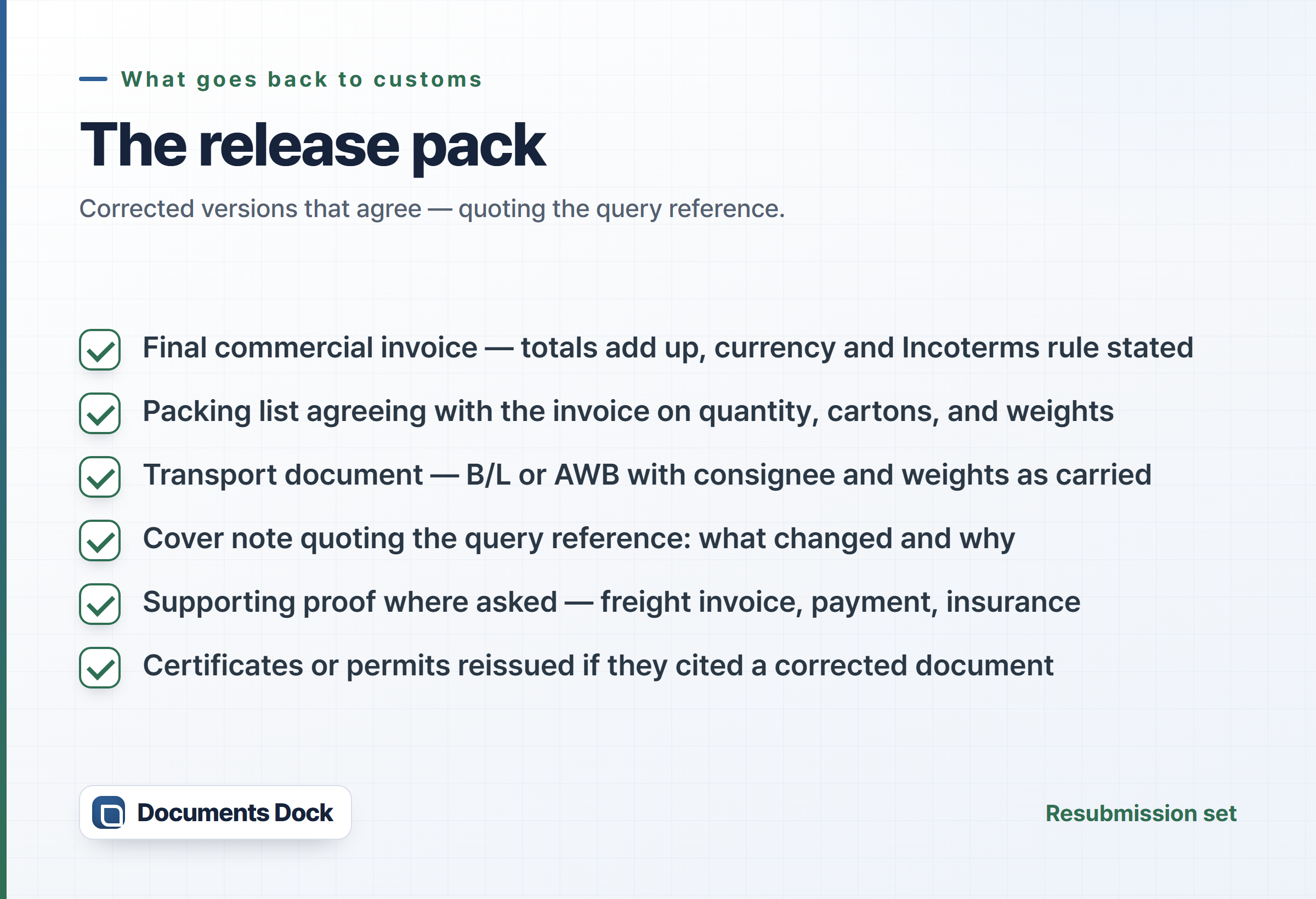
For a document-triggered hold, customs typically needs the corrected core papers — the final commercial invoice, the packing list, and the bill of lading or air waybill, in agreement — plus whatever the query asked for: an explanation letter, proof of payment, a freight invoice, or a permit or certificate if the goods require one.
The release pack mirrors the set the declaration was built from — the same documents mapped in the full export document set, in order. Two things matter more in a hold than in routine filing: quote the query's exact reference (the entry or declaration number), and send versions that agree — a corrected invoice beside an uncorrected packing list reopens the hold. Country lanes add their own layer: a Singapore import runs through a declaring agent and permit system — see our Singapore import customs documents guide.
- The final commercial invoice — values that add up, currency stated, Incoterms 2020 rule with named place
- The packing list — quantities, cartons, and weights agreeing with the invoice and transport document
- The transport document — B/L or AWB, with the consignee and weights as carried
- A short cover note — quoting the query reference and stating what changed and why
- Supporting proof where asked — freight invoice, insurance certificate, proof of payment, contract or order
- Certificates and permits where required — reissued if they referenced a corrected document
How do you fix documents while the shipment is held?
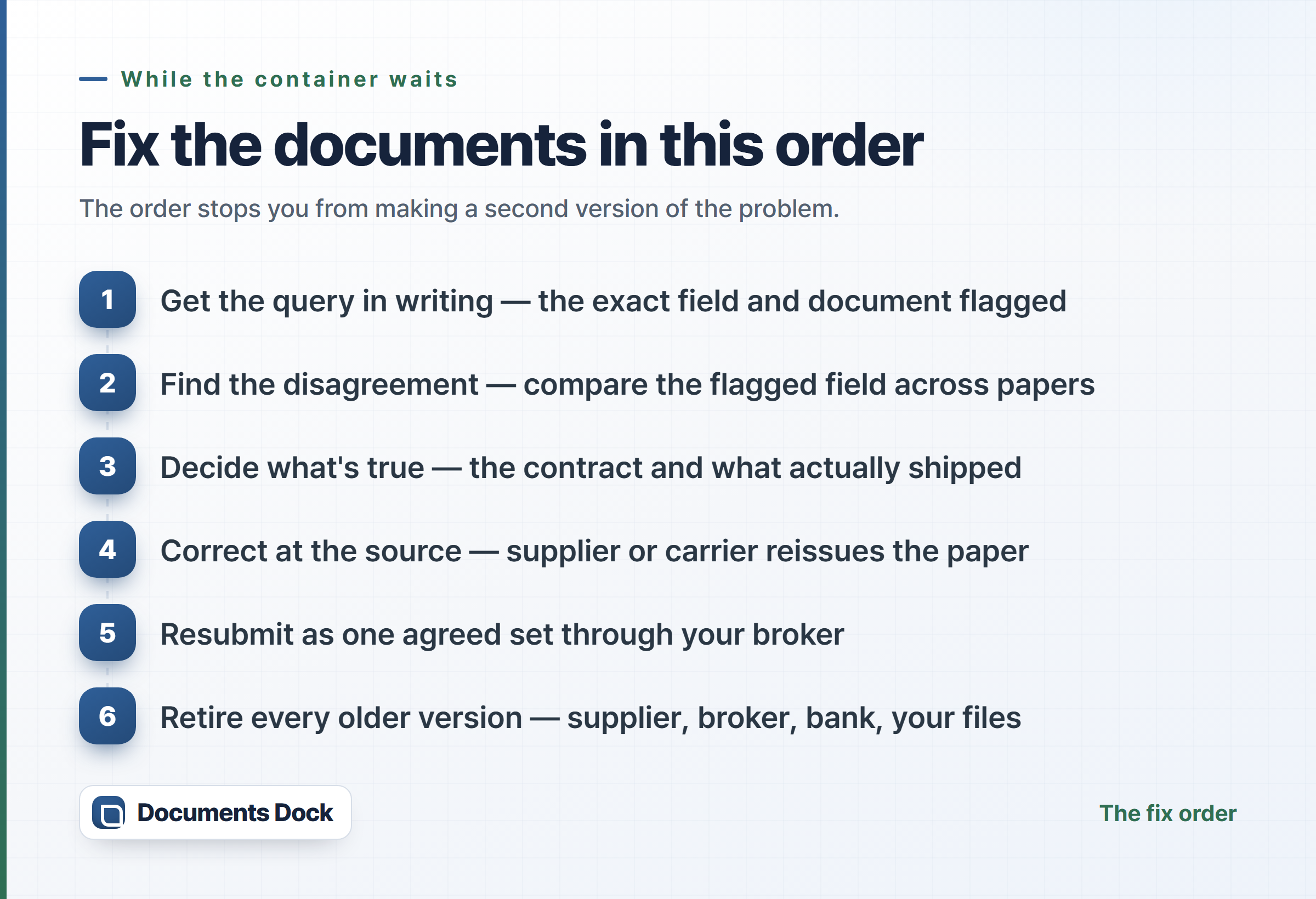
You fix a held shipment's documents in a fixed order: pin down the exact query, find which two papers disagree, decide which answer is true, correct at the source, and resubmit a single agreed set through your broker. The order stops you from making a second version of the problem:
- Get the query in writing. Ask your broker for the exact field and document customs flagged — 'a documents issue' is not actionable; 'declared value differs from invoice presented' is. If it cites inspection, permits, or samples instead of a document field, you are on the goods-side track — this order does not apply.
- Find the disagreement. Lay the three documents side by side and compare the flagged field across them — pairs, not pages.
- Decide which answer is true. Anchor on what was agreed and what physically shipped — the contract and the cargo — not on whichever paper is easiest to edit.
- Correct at the source. The supplier reissues the invoice or packing list; bill of lading amendments go through the carrier or forwarder and can carry fees and delay, so start early.
- Resubmit as a set. Send the corrected documents together through your broker — not the corrected page alone.
- Retire the old version. The corrected set becomes the only one in circulation — supplier, broker, bank, and your own records.
One fix can create the next mismatch
Documents reference each other: a reissued invoice with a new value or number can orphan the certificate of origin or insurance certificate issued against the old one. Before resubmitting, check what else cited the corrected document and have it reissued too — or the next desk finds the next disagreement.
The same check, one shipment earlier
Everything above also reads as a prevention list: the same three fields, read across the same three papers, while every document can still be amended without a port clock running. If your team touches the set at only one moment, make it the moment before the declaration is filed.
When the corrected set is ready, the last step is getting the right versions to the right desks. Build the per-recipient bundle — broker, bank, partner — in one place with Documents Dock, so the copy that cleared customs is the copy everyone holds: documentsdock.com.
Sources and scope
This is general information, not customs or legal advice. Why a shipment is held — and what will release it — depends on your goods, the countries involved, and the declaration as filed; confirm specifics with your licensed customs broker or the customs authority handling it.
- WTO, Trade Facilitation Agreement (release and clearance of goods, right to review) — wto.org
- WTO, Customs Valuation Agreement (Agreement on Implementation of Article VII of GATT 1994) — wto.org
- ICC, Incoterms 2020 rules — iccwbo.org/business-solutions/incoterms-rules/incoterms-2020
- U.S. International Trade Administration (ITA), Common Export Documents — trade.gov/common-export-documents