
A refusal that goes out on the sixth banking day is not, in the end, a refusal. An issuing or confirming bank that misses the window is precluded from calling your documents discrepant at all — whatever is actually wrong with them.
A letter of credit discrepancy is any respect in which a presentation fails to comply with the terms of the credit, the applicable provisions of UCP 600, and international standard banking practice — the three-part test article 2 uses to define a complying presentation. Banks decide it from the documents alone, as they appear on their face (article 14(a)).
Most of what goes wrong in a presentation goes wrong before the bank ever sees it — at the border (why customs rejects your documents) or in a free port where the bank is the only hard reader (why the bank checks your documents, not customs). This piece starts at the counter: the day the set is presented, and the five that follow.
Conflict, not difference — the sentence the examination turns on
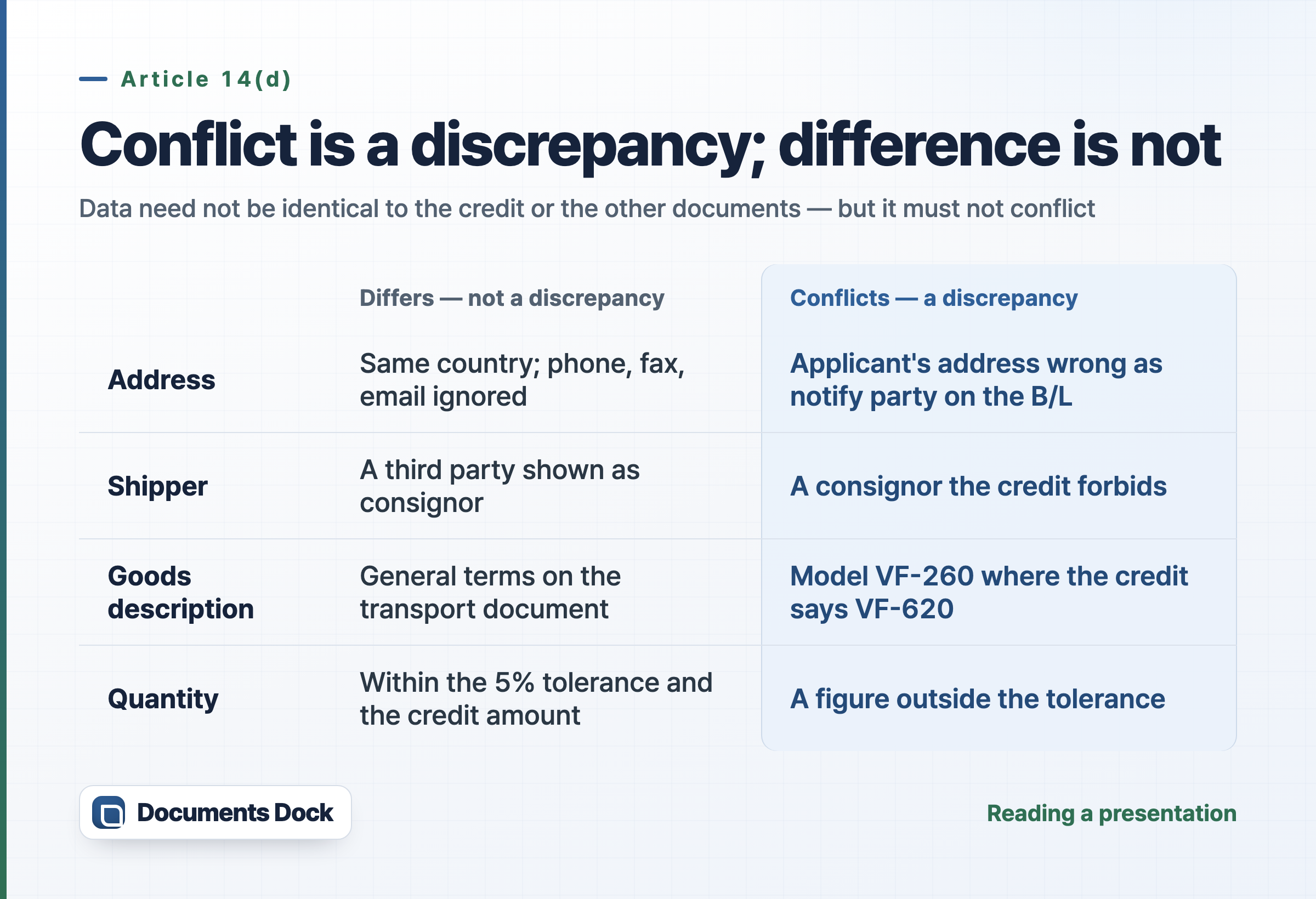
A conflict is a discrepancy. A difference is not. Article 14(d) is the sentence the whole examination turns on: data in a document, read in context with the credit, the document itself and international standard banking practice, "need not be identical to, but must not conflict with" data in that same document, in any other stipulated document (any document the credit calls for), or in the credit.
Take one shipment of vacuum flasks. The credit describes "stainless steel vacuum flasks, 500 ml, model VF-620", and your commercial invoice carries a description corresponding to it — copying the credit's wording is the safe route, since article 18(c) requires correspondence, not a rearrangement you would have to defend. The bill of lading says only "stainless steel flasks" — shorter, and not a discrepancy: a general description is acceptable on every document except the invoice (article 14(e)), and both statements are true of the same cartons. Now transpose two digits, so the packing list reads "model VF-260". Nothing about the goods has changed, but the two statements can no longer both describe one shipment, and that is a discrepancy. The transport document is the one worth checking first, because the carrier writes it rather than you — telex release vs original bill of lading sets out how to match it to the credit.
UCP 600 then names differences that are not discrepancies at all:
- **Addresses that do not match.** Beneficiary and applicant addresses need not be those in the credit, provided they sit in the same country, and telephone, fax and email details given as part of an address are disregarded. The exception catches people: where the applicant's address and contact details appear as part of the consignee or notify party details on a transport document under articles 19 to 25, they must be as the credit states (article 14(j)).
- **A shipper who is not you.** The shipper or consignor shown on a document need not be the beneficiary of the credit (article 14(k)) — which is what makes a re-export presentable at all.
- **A short goods description.** Only the commercial invoice must carry a description corresponding to the credit's (article 18(c)). On every other document a general description is acceptable, so long as it does not conflict (article 14(e)).
- **A quantity that is not exact.** Where the credit does not state quantity as a number of packing units or individual items, and the drawing — the amount claimed under the credit — stays within the credit amount, a tolerance of 5% more or less is allowed (article 30(b)). "About" before an amount, quantity or unit price means 10% more or less (article 30(a)).
Identical is not the standard
Rewriting a transport document to quote the credit's full goods description does not make it more compliant — it makes it likelier to conflict with what the carrier will actually certify. Match the invoice to the credit; let the rest stay general and true.
How long does a bank have to check your documents?
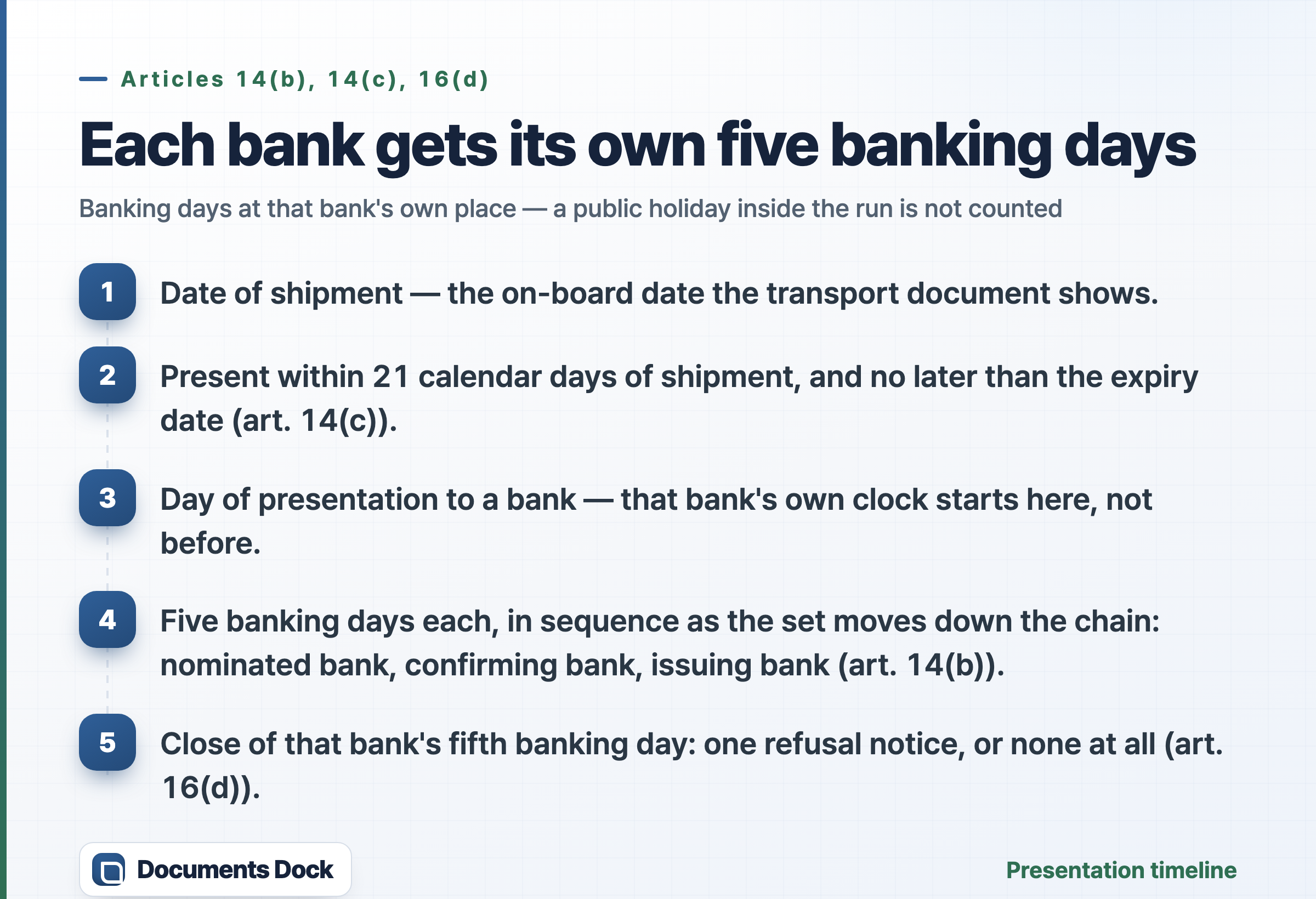
A maximum of five banking days following the day of presentation — and each bank in the chain gets its own five, counted from the day the set reaches it. The issuing bank (the buyer's bank, which opened the credit), a confirming bank (a bank that has added its own undertaking to honour or negotiate, alongside the issuer's) and a nominated bank acting on its nomination (the bank the credit authorises to pay, accept or negotiate) each have that period to decide whether the presentation complies (article 14(b)). Not five between them — five each. They run in sequence, as the set moves down the chain: the issuing bank's clock starts when it receives the documents from the nominated bank, often a week or more after the beneficiary crossed the counter.
They are banking days at the examining bank's own place, so a public holiday inside the period pushes the answer later without breaching anything, and no bank is obliged to accept a presentation outside its banking hours (article 2, definition of banking day; article 33). Nor do the credit's own dates shorten the period: if the expiry falls on day two of the examination, the bank still has its five days.
Two other clocks bind you rather than the bank. A presentation including one or more original transport documents under articles 19 to 25 must be made within the presentation period the credit states — or, where the credit states none, no later than 21 calendar days after the date of shipment — and in any event not later than the expiry date (article 14(c)). And an issuing bank that approaches the applicant for a waiver does so in its sole judgement — it does not buy itself extra days (article 16(b)).
What happens if the bank misses the deadline?
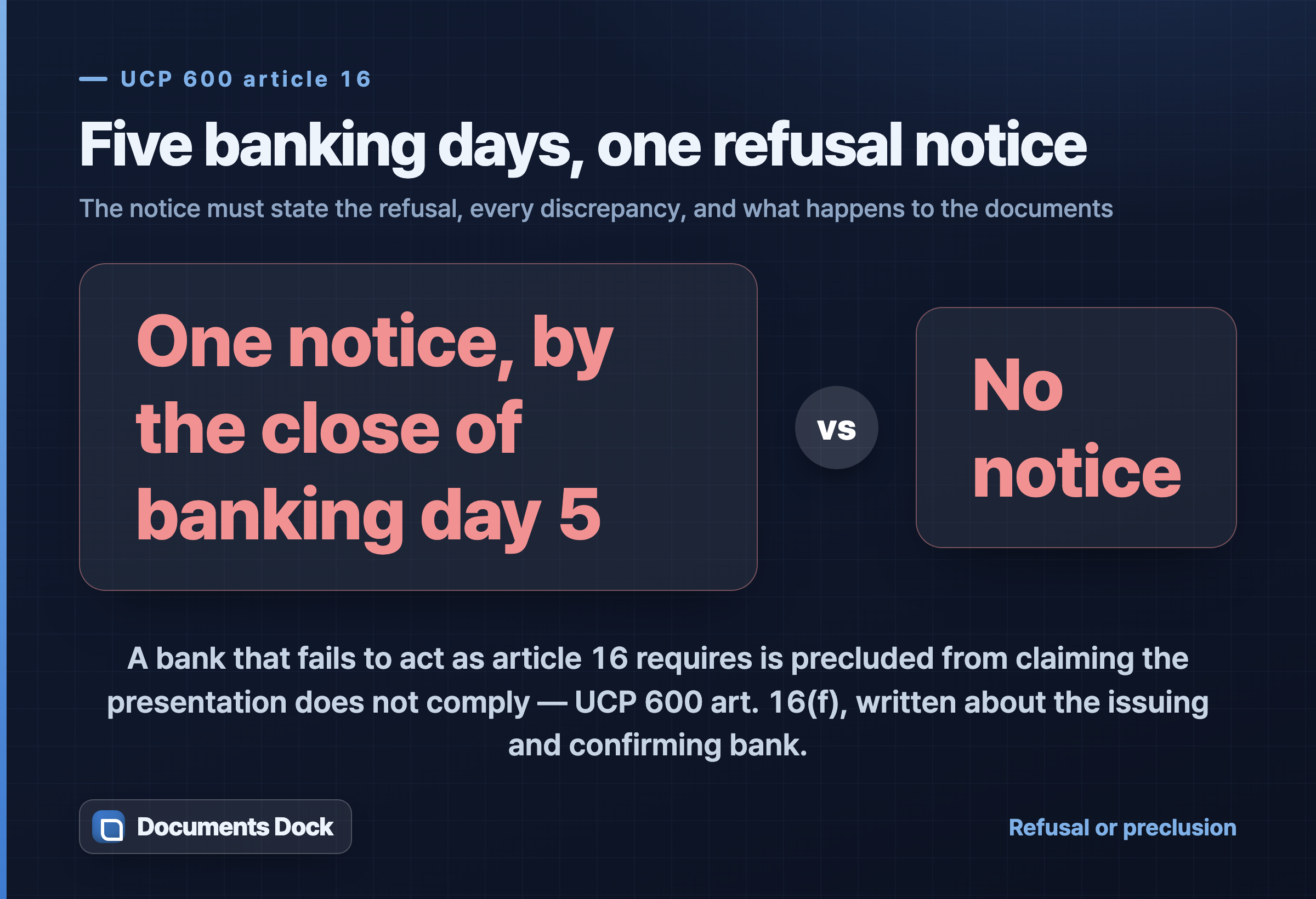
It loses the right to call the documents discrepant. An issuing bank or a confirming bank that fails to act as article 16 requires is precluded from claiming that the presentation does not comply (article 16(f)). The documents stand as complying, whatever is wrong with them. Article 16(f) is written about those two banks only: a nominated bank's five days are just as real, but the preclusion is not stated to reach it.
Article 16 is exact about what acting means. A bank deciding to refuse must give a single notice to the presenter — whoever actually made the presentation, which is often the beneficiary's own bank rather than the beneficiary — by telecommunication or, where that is not possible, by other expeditious means, no later than the close of the fifth banking day following the day of presentation (articles 16(c), 16(d)).
That one notice must say three things. First, that the bank is refusing to honour or negotiate — to pay under the credit, or to buy the documents from you. Second, each discrepancy it refuses for: a discrepancy not named in that notice cannot be raised in a second notice a week later. Third, what is happening to the documents — held pending your instructions, held by the issuing bank pending the applicant's waiver (an option open to the issuing bank alone), being returned, or handled under instructions you gave earlier.
So the refusal notice is itself a document to read: late, silent on what is happening to the documents, or adding fresh grounds a week on. Put any of those to your bank in writing, through the bank that presented; preclusion turns on the facts of a presentation, not on an assertion made by telephone.
A waiver is not a cure
Article 16(b) lets the issuing bank ask the applicant to waive the discrepancies, and buyers often do. But that is the buyer's decision, and the five days run regardless. A presentation that depends on a waiver leaves the buyer deciding whether you get paid, at a moment when the market may have moved against you.
What must the insurance document show?
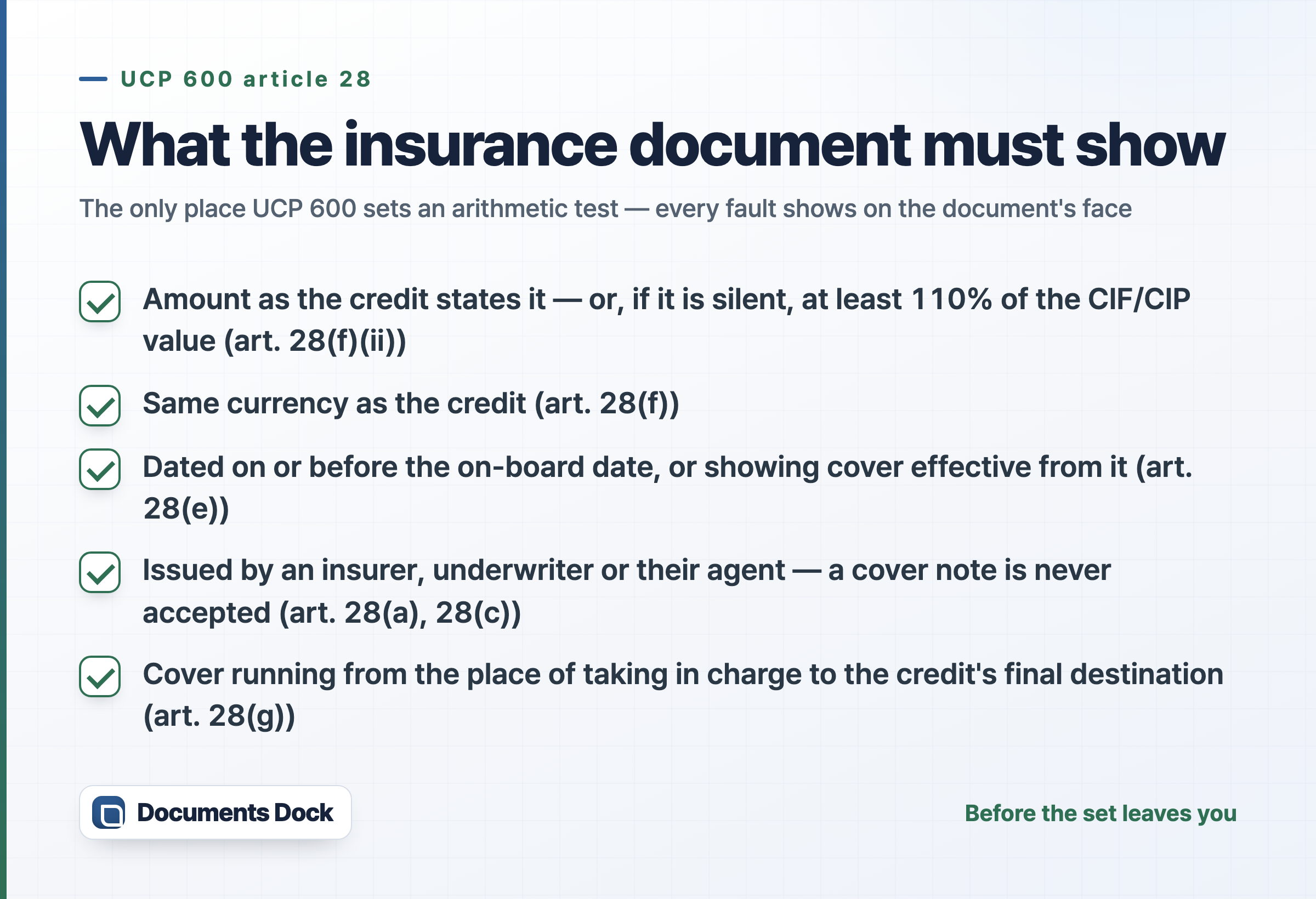
An amount, a date, an issuer and a route. Where a credit calls for insurance — in practice, a CIF or CIP sale — article 28 fixes all four. It earns its own section because it is the one document where the whole test is arithmetic — an amount, a currency and a date you can check against the credit at your own desk before the set leaves you.
- **An amount the credit is satisfied with.** Where the credit states the cover it requires, that figure is the minimum — cover above it is not a discrepancy unless the credit caps it. Where the credit gives no indication, the minimum is 110% of the CIF or CIP value of the goods, in the same currency as the credit (articles 28(f)(i), 28(f)(ii)) — and where that value cannot be determined from the documents, cover is measured against the amount for which honour or negotiation is requested, or the gross invoice value, whichever is greater.
- **A date no later than the date of shipment** (article 28(e)) — unless the document itself shows cover was effective from a date not later than shipment. A certificate issued three days after the on-board date, on a policy that in fact covered the voyage, is refused for what it fails to say.
- **An issuer with standing**: an insurance company, an underwriter, or their agents or proxies (article 28(a)). A cover note — the broker's provisional advice that insurance has been arranged, not a covering letter — is not accepted (article 28(c)). A policy is accepted in place of a certificate or a declaration under an open cover, the standing policy that covers shipments as they occur (article 28(d)).
- **A route matching the credit's** — at least from the place of taking in charge or shipment to the place of discharge or final destination stated in the credit (article 28(g)).
Two 110% figures, one number
Where the credit is silent, its default and your sale's minimum happen to agree. Incoterms 2020 already puts a CIF or CIP seller at 110% of the contract price in the contract currency, at Institute Cargo Clauses (C) for CIF and the wider Clauses (A) for CIP (who pays for shipping, insurance and customs). A credit may demand more, and where it does, the credit governs.
What the rules change about how you build the set
Four things, none of them proofreading harder.
- **Hunt conflicts, not differences.** Two figures that cannot both describe one shipment are the target; two documents wording one fact differently are not — the same read that the full export document set, in order lays out across the sequence.
- **Draft the invoice description from the credit, not from the order.** The credit was issued on wording the buyer lifted out of the proforma you sent them, so compare the two the day the credit arrives, then build the invoice from the credit — how to write a commercial invoice covers the description field, and commercial invoice vs packing list covers what the rest of the set has to repeat.
- **Put the dates in issue order.** Insurance dated on or before the on-board date; presentation inside the credit's presentation period and inside the expiry. A reissued document carries a new date, and a new date cannot fix an order the old dates already broke.
- **Record the day of presentation.** Every deadline above, yours and the bank's, is counted from it — which counter, which day, and what the set contained.

One date runs every clock here
Documents Dock keeps the credit, the set presented against it, and the date it went to the counter in one shipment record, with the bank's notice filed beside them — so a second presentation is built from what was actually sent rather than from what was meant to be sent — documentsdock.com.
Where these rules come from, and what they don't decide
This is general information, not legal or banking advice. UCP 600 governs a credit only where the credit's text says so, and its articles can be modified or excluded by the credit itself (article 1). Whether a presentation complies, and whether a bank has precluded itself, turns on the facts of that presentation — confirm with your bank or a documentary-credit specialist.
- International Chamber of Commerce (ICC) — Uniform Customs and Practice for Documentary Credits (UCP 600), articles 1, 2, 14, 16, 18, 28, 30 and 33 — iccwbo.org
- International Chamber of Commerce (ICC) — International Standard Banking Practice for the Examination of Documents under UCP 600 (ISBP 821, 2023) — iccwbo.org
- International Chamber of Commerce (ICC) — Incoterms 2020 rules, CIF and CIP insurance obligations (A5) — iccwbo.org/business-solutions/incoterms-rules/incoterms-2020
- ICC Banking Commission — DOCDEX rules for documentary-credit disputes — iccwbo.org/dispute-resolution-services/docdex
- U.S. International Trade Administration — Trade Finance Guide: Letters of Credit — trade.gov/letter-credit