
Every other field on a commercial invoice records something you already know: what you sold, what you charged, where it is going. The HS code records something a customs authority will decide, and you are filling it in ahead of them.
An HS code is the tariff classification of goods under the Harmonized System. The code that belongs on your commercial invoice is the one the destination country will read: its first six digits are internationally common, and any digits after that are national. It is a claim about what the goods are, not a duty rate.
This guide covers where the code comes from, who answers for it, and what a wrong one costs. It does not classify your goods for you — no article can — and it does not cover the rest of the document (how to write a commercial invoice).
What is an HS code, and how much of it is the same everywhere?
The Harmonized System is an international nomenclature for classifying traded goods, maintained by the World Customs Organization and used by most trading economies as the basis of their own tariff and statistical schedules.
Its structure is fixed to the sixth digit: two digits for the chapter, four for the heading, six for the subheading. Contracting parties classify the same goods to the same six digits, which is why the subheading is the only part of the number that is safe to send abroad without also saying whose schedule you took it from.
Past the sixth digit, countries extend the code for their own tariff and statistical purposes, and both the length and the meaning of those extra digits are theirs alone. Two national codes that open with the same six digits can carry different duties, different controls, and different reporting.
So an invoice quoting a national code without naming its country is quoting a number half the world cannot use — and one quoting six digits is understood everywhere but is not yet enough to file a declaration with.
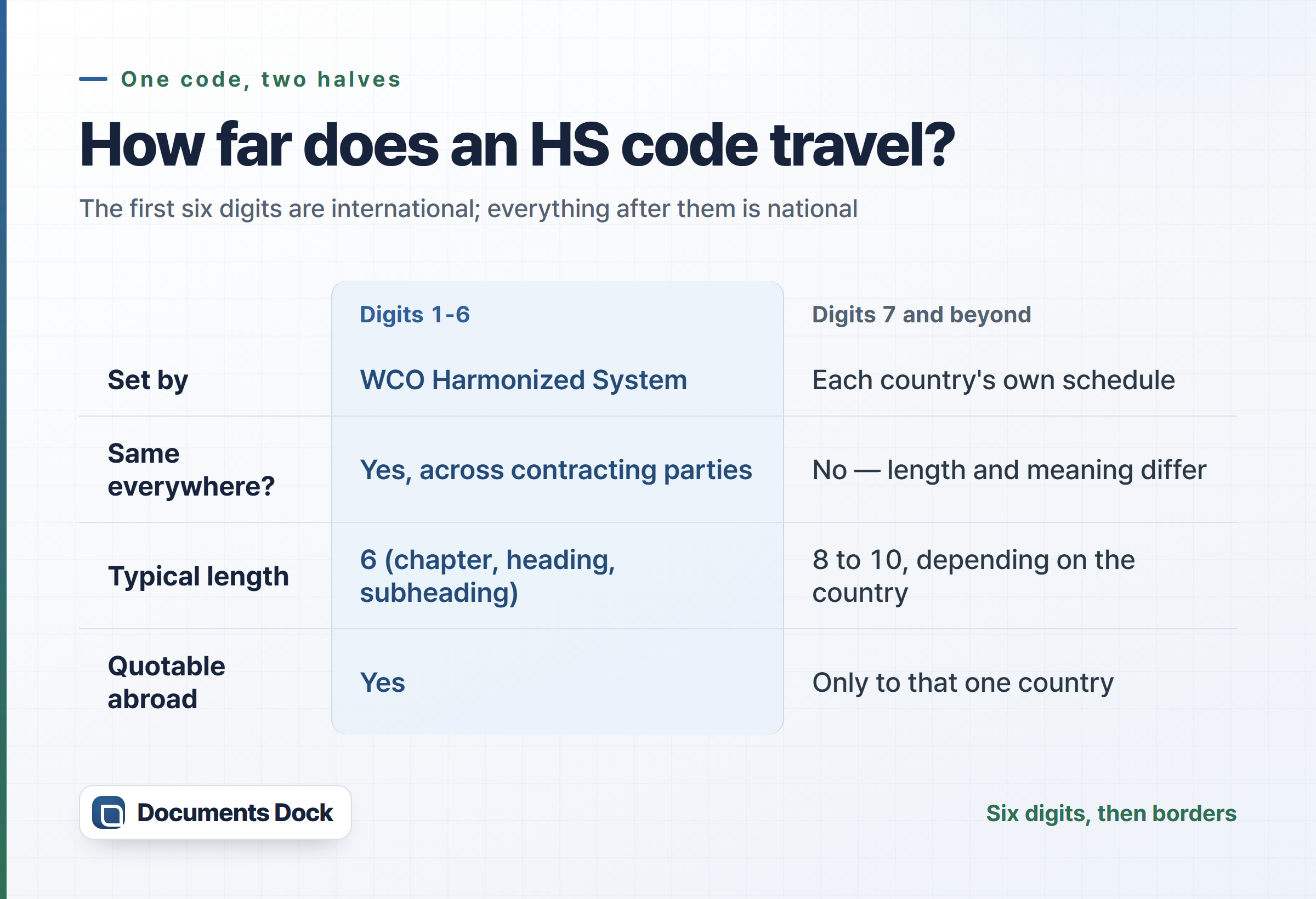
Six digits travel; the rest stay home
A six-digit subheading means the same thing wherever it lands. Anything past it is only meaningful once you say which country's schedule it came from.
Does an HS code tell you the duty you will pay?
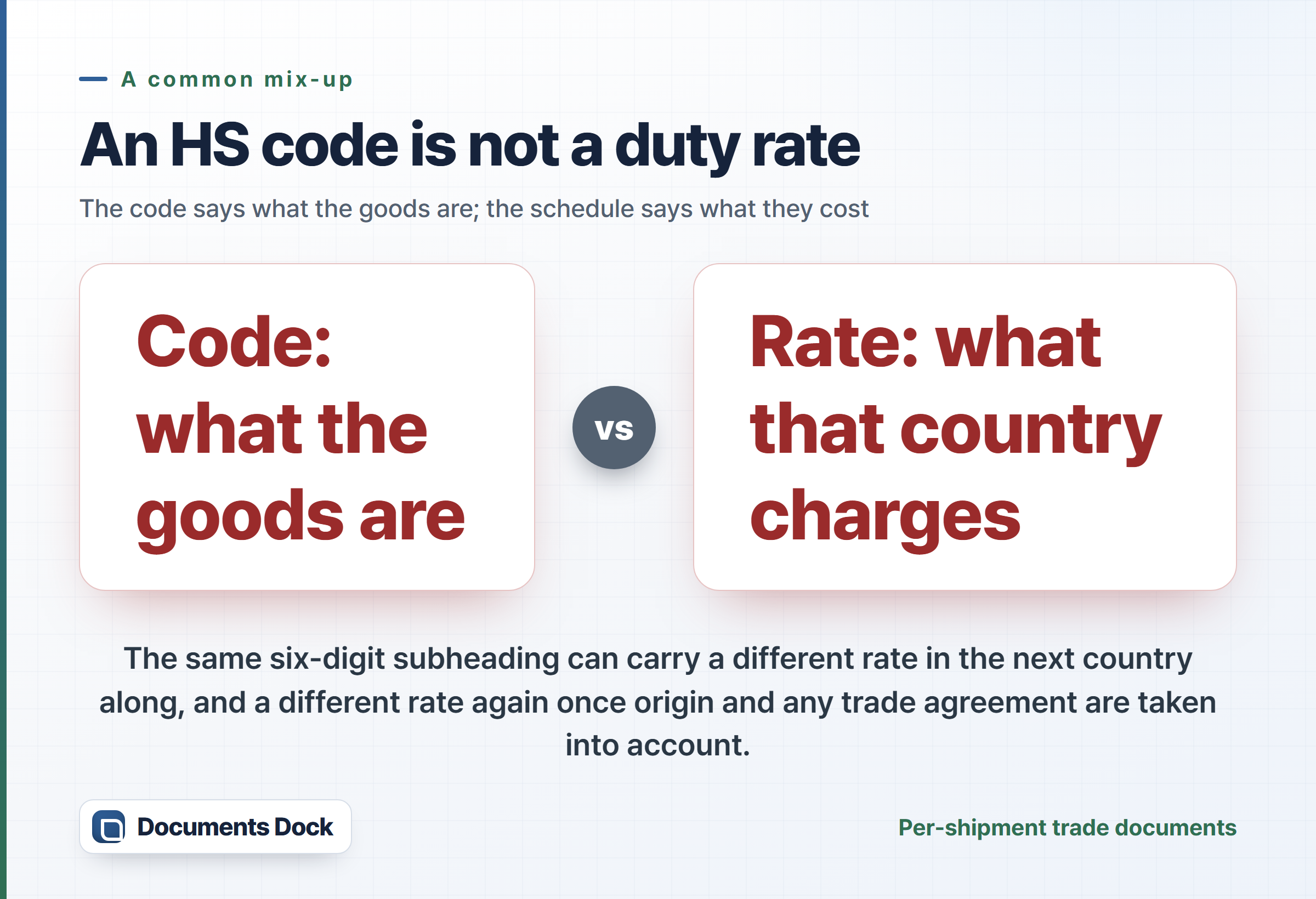
No. A code identifies goods; it does not price them. The duty owed is found by reading that code against the destination country's tariff schedule, and the same subheading can carry a different rate in the next country along.
Origin then changes which rate that code attracts. A rate applies to goods of a given classification from a given origin, so a preference claimed under a trade agreement, a measure aimed at one source, or a quota can all change what is payable while the code stays exactly as it was.
This matters most when you are quoting. A seller who tells a buyer that duty on a code is a certain percentage is quoting one country's schedule on one day, and buyers plan around it. Send the code and the origin, and let the importing side read their own schedule against both.
Who is responsible for the HS code on the invoice?
In most import regimes the party declaring the goods answers for the classification — the importer of record, or the declarant acting for them — even where the code was typed by a seller on the other side of the world.
That is not licence for a seller to be careless with it. The broker preparing the entry usually starts from what the invoice says, and a code that arrives with the paperwork tends to be the code that gets filed. Where it is wrong, the correction happens at the border, on the importer's clock and at the importer's cost.
A customs broker files the entry and a good one will push back on a code that does not fit the description, but filing is not the same as owning the answer: brokers act on the information given to them, and the declarant stays the party the authority pursues. The importer is not a passive recipient here either — they request the code, reconcile it against what they ordered, and supply the declaration data behind it.
The arrangement between the two sides is worth writing down once. Agree who proposes the code, who checks it, and what happens when they disagree — before the first shipment, rather than during the first query.
A code from the seller is a proposal, not a decision
The importer or their declarant is normally the party held to the classification. Send the code and the description behind it, and let the declaring side confirm it before entry.
How do you find the right HS code?
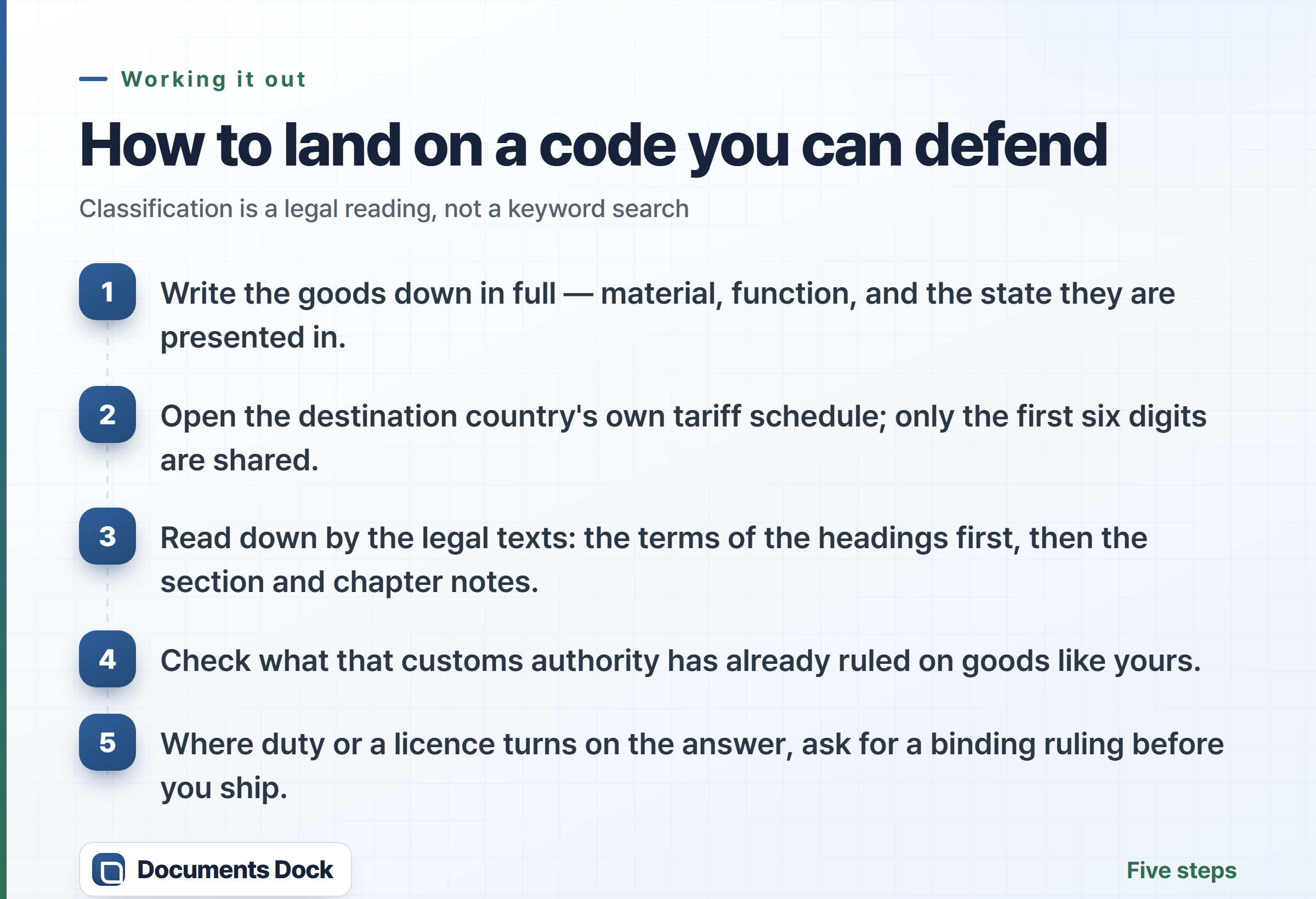
Start from a full description of the goods, then work down the destination country's published tariff schedule using its legal texts — the terms of the headings and the section and chapter notes — rather than a keyword match.
Classification is a legal reading, not a lookup. The Harmonized System carries its own General Rules for the Interpretation, and the first of them settles classification by the terms of the headings and any relative section or chapter notes. A search box that matches your product name is a way of finding candidate headings, not an answer.
What decides the heading is usually material, function, and the state the goods are in when they are presented. Two products a catalogue treats as one line can sit in different headings because one is put up for retail sale and the other ships in bulk, or because one arrives assembled and the other as parts.
Where the answer is close, or where money and controls turn on it, ask instead of guessing. Many customs authorities publish their past classification decisions, and several run a formal advance-ruling procedure that binds them for a period: the United States issues binding rulings through U.S. Customs and Border Protection, and the European Union issues Binding Tariff Information decisions. The names, the scope, and the lead times differ, so check what your destination offers before you need it.
- **What it is made of** — the material or materials, and which of them predominates.
- **What it does** — the function the goods are designed to perform.
- **How it is presented** — assembled or unassembled, retail packed or in bulk, a complete article or a part.
- **Which country reads it** — the destination's schedule decides everything past the sixth digit.
What happens if the HS code is wrong?
The customs authority reclassifies the goods, and the correction is rarely confined to the duty line. Expect the entry to be amended, the difference in duty and import taxes to be settled in whichever direction it runs, and release to wait while that happens.
Underpayment is the case everyone pictures. It is recovered, normally with interest, and in many regimes with a penalty where the authority decides the error was avoidable rather than honest. Overpayment is the quieter loss: duty paid against a classification that never applied is money most importers never go back for, and refund routes close after a set period.
Two consequences are less obvious and cost more. Many import controls, licences, and permits are written against tariff codes, so a wrong code can leave a shipment looking unrestricted right up to the moment it isn't — and a permit that was supposed to exist before arrival is an awkward thing to arrange after it.
The other is origin. Many rules of origin are written as a change of tariff classification: the inputs have to move from one heading to another during production. If the classification is wrong, the rule being tested is the wrong rule, and a preference claimed on it goes with it (do you need a certificate of origin?).
Corrections also age badly. Classification is normally reviewable long after release, and an authority that finds one wrong code tends to look at the rest of the file.

The duty difference is usually the smallest part
A misclassification can also hide a licence requirement and void an origin claim keyed to a change of tariff heading. Both cost more to unwind than the duty did.
Where does the code have to agree?
A code is read next to the description sitting beside it, and that description is read next to every other document in the set. A defensible code can still fail because the paperwork around it disagrees.
- **The invoice's own description** — a code and a description pointing at different goods is the mismatch read first.
- **The packing list** — same goods, same line structure, nothing merged or split between the two (how to write a packing list).
- **The customs declaration** — the code your broker files should be the code you were told they would file.
- **The origin document** — where a preference is claimed, the rule was tested against a heading, and the certificate and the invoice have to name the same one.
- **Any documentary credit** — a credit's goods description is examined as worded, so an invoice rewritten around a new code still has to fit the credit.
Inconsistency is the more common failure
Shipments are held far more often for two documents disagreeing than for a code being indefensible — the field-level version of that is set out in why customs rejects your documents.
Decide the code before the invoice needs it
The HS code is one of the few invoice fields that cannot be produced by looking at the transaction, which is why it should not be produced at invoicing. Work it out at quotation, when there is time to read the schedule and, where it matters, to ask for a ruling — then reuse it, rechecked whenever the product changes. Where the invoice sits relative to everything else is mapped in the full export document set, in order.
A classification is only as good as the last document that repeated it. Documents Dock keeps the invoice, the packing list, and the issued copies of one shipment together, and flags where a description or a figure has stopped agreeing across them — documentsdock.com.
Sources and scope
This is general information, not a classification opinion. The correct code for your goods, the duty that follows from it, and the controls attached to it depend on the goods, the destination, and the origin — confirm with a licensed customs broker or the destination's customs authority, and use an advance ruling where one is available and the answer matters.
- World Customs Organization (WCO) — Harmonized System nomenclature and the General Rules for the Interpretation (wcoomd.org)
- World Customs Organization (WCO) — Harmonized System classification decisions and Explanatory Notes, overview (wcoomd.org)
- U.S. Customs and Border Protection — binding rulings and the Customs Rulings Online Search System (cbp.gov)
- European Commission, Taxation and Customs Union — Binding Tariff Information (BTI) (taxation-customs.ec.europa.eu)
- International Trade Administration (trade.gov) — Harmonized System (HS) codes and how to find them (trade.gov)